Is Buddhism a Religion or Philosophy?
Many people have questions about the nature of Buddhism. Most notably, they wonder if Buddhism is a religion or not. Some call it a religion, while others call it a philosophy or a way of life. Many, like myself, have some resistance to the idea of religion when first coming to meditation practice.
When people ask me if I am Buddhist, I often reply that I practice Buddhism. Identifying in any way (as Buddhist or not) doesn’t really serve me. Instead of “being Buddhist,” I “practice Buddhism.” Instead of building an identity, I focus on my actions. To be completely transparent, I think the true answer to the question about the nature of Buddhism is a bit irrelevant in the big picture. What matters is how we practice, not what we call it. I will elaborate on that more toward the end of this post.
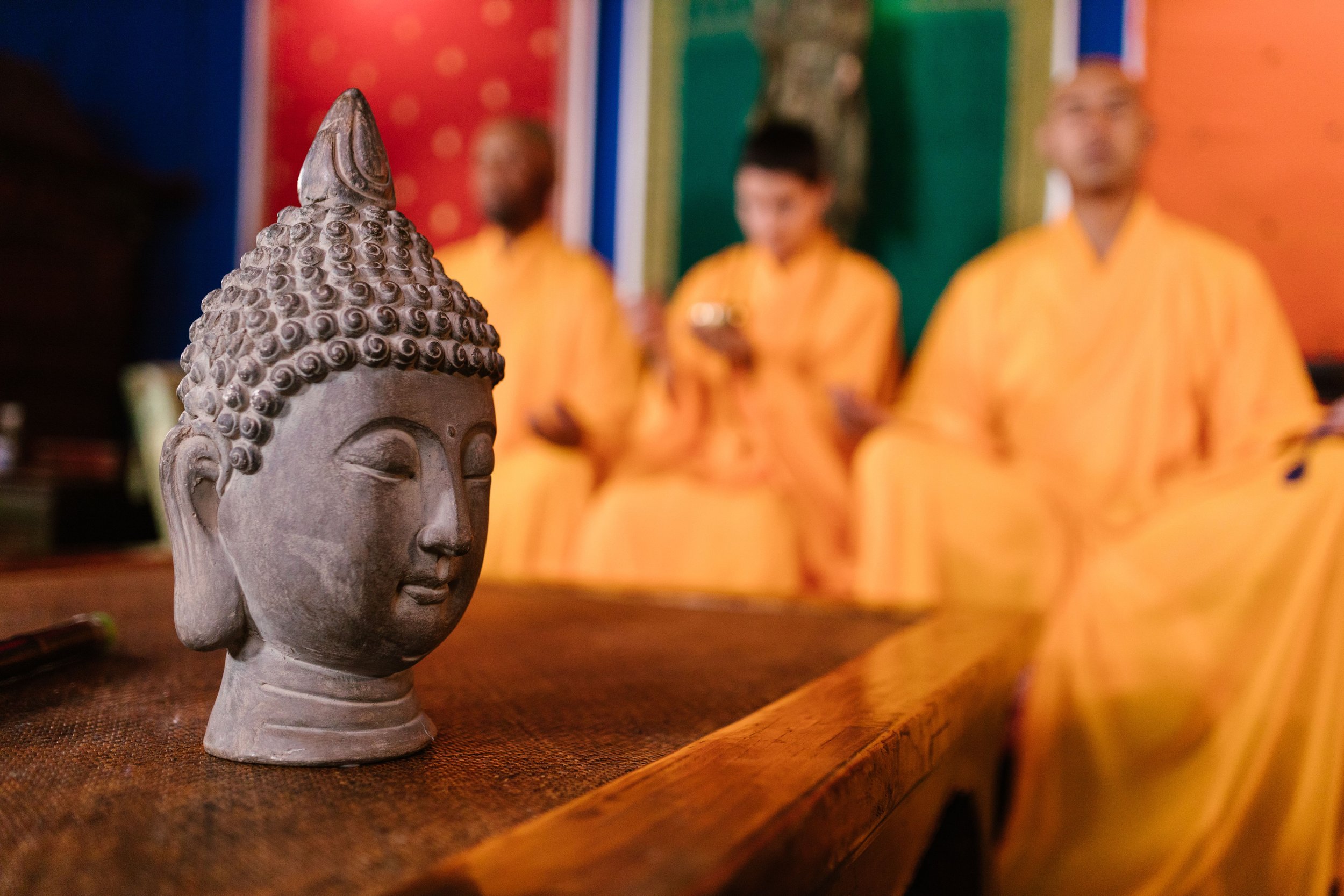
Difficulties in Categorizing Buddhism
Like many religions and philosophies, Buddhism can be difficult to categorize. It is not a monolith. Buddhism has traveled to various countries, encountered various local cutures and traditions, and evolved over the years. As such, Buddhism from one place to the next can be quite different.
Think of the basket of Christianity. Roman Catholocism is quite different from more modern Pentocostalism. Classical Marxism is not the same as Trotskyism or Maoism. I could give countless examples, but you get the idea.
I will cover this topic to the best of my ability, looking at Buddhism in the East and West, how it is practiced as a religion and philosophy, and what it means for your personal practice. But to answer the original question (in my opinion) clearly here toward the top: Buddhism is traditionally a religion. The way it is practiced in some schools in the West is much less religious and more philosophical.
Buddhism in the East
I have had a few conversations over the years where someone insists Buddhism is a philosophy or way of life. I don’t like to engage in argument over this topic, as I frankly don’t think it matters much for one’s practice. But one thing I do always say is that a few hours in Southeast Asia might have you questioning whether or not Buddhism is a religion.
I have spent time in Sri Lanka. You can’t even leave the airport without encountering shrines, monks, and chanting. In some countries, such as Thailand, young men are largely expected to ordain as monastics for a time. You’ll find monks passing through town on their almsround (asking for food). On Thai New Year (Songkran), Buddha statues are ritually bathed.
In addition to cultural norms and holidays like Vesak (the Buddha’s birthday/enlightenment/death), Buddhism is practiced in a way that may seem foreign to Westerners. Many traditions have plenty of devas or bodhisattvas, supernatural beings. As Buddhism meshes with local culture and folkloric tradition, you will find variations from location to location.
Many traditions chant suttas (discourses) in traditional languages like Pali, Sanskrit, or Classical Chinese. Mantra recitation is common, and traditions like Pure Land in China and Japan are essentially salvation-by-faith practices. Many laypeople can be found in various countries praying to images of the Buddha and bodhisattvas, and supernatural aspects like divination and astral projection can be found in many schools of Buddhism.
Buddhism in the West
As Buddhism spreads, it changes. When Emperor Ashoka backed Buddhism in the 3rd century BCE, he sent missionaries to Sri Lanka, Central Asia and Ancient Greece. In China, Buddhism mixed with Taoist and Confucianist thought and became Chan, which later became Zen in Japan. Indian tantric traditions influenced Buddhism in the area, giving rise to Vajrayana.
When Buddhism came to the West, the teachers brought specific teachings with them. These were teachings that ended up taking hold among Westerners, but not the entirety of Buddhism. And, Buddhism mixed with local culture and thought to produce a new type of Buddhism
In this case, Buddhism largely mixed with secularism and modern science/psychology. With an emphasis on psychological understanding, Westerners looked at the practices of Buddhism (specifically mindfulness) through a new lens. Traditions like vipassana/insight meditation and MBSR are largely secular, free of talk of deities, and relatively ritual-free.
The “religious” aspects were left behind. Perhaps the teachers who brought Buddhism over thought the religious aspects wouldn’t be palatable. Or perhaps people just found mindfulness to be the most useful aspect. But Buddhist cosmology, rituals, and devotional practices were largely left behind. Core concepts like karma and samsara have even been lost a bit in the West.

Better or Worse Buddhism
I want to pause here to recognize how different Buddhism is from country to country. Yes, Buddhism has many more religious aspects in Tibet than San Francisco. But I don’t want to feed the idea that one is inherently better than the others. New York City pizza is very different from a traditional Neapolitan pizza in Italy. But one isn’t inherently better; one is older. You may like one better personally.
My experience is that introductory Western Buddhism left some holes for me, and I was called to investigate more aspects of Sri Lankan, Burmese, Vietnamese and Thai Buddhism (so far) to supplement my understanding. But at their core, the teachings are fairly similar.
We find the base teachings like the Noble Eightfold Path in these traditions. The way we actually practice Buddhism may be different, and we may use slightly different discourses. It’s like a dance. You and I may hear the same song, yet our dancing may be slightly different. Hopefully we’re both on beat, but the movements differ.
I say this to discourage any attachment to one type of Buddhism as the “right” kind. I’ve encountered this repeatedly at various monasteries and in different countries. Instead of looking for the “best” type of Buddhism, focus on practicing in a way that works for you. What brings you closer to freedom, and lessens your suffering? That’s what matters.
Why Buddhism is a Religion
By nearly any traditional definition, Buddhism is a religion. I know it’s cliche, but I’m going to cite a dictionary definition here. The Encyclopedia Britannica’s entry on religion starts,
“Human beings’ relation to that which they regard as holy, sacred, absolute, spiritual, divine, or worthy of especial reverence. It is also commonly regarded as consisting of the way people deal with ultimate concerns about their lives and fate after death. In many traditions, this relation and these concerns are expressed in terms of one’s relationship with or attitude toward gods or spirits; in more humanistic or naturalistic forms of religion, they are expressed in terms of one’s relationship with or attitudes toward the broader human community or the natural world.”
It goes on to mention the importance of texts, spiritual leaders, prayer/meditation/rituals, moral conduct, and several other aspects that are directly relevant to Buddhism. It even specifically links to Buddhism in the article.
For many, Buddhism is a non-theistic religion. There isn’t a focus on a creator god or deity in many places, which leads people to believe it is not a religion. In fact, places like South Korea, Thailand, and Japan have plenty of people who practice Christianity but engage in Buddhist practices of merit-making, meditation, and Buddhist festivities.
Even in the West, there are more religious aspects than we often want to recognize. Because there isn’t a strong focus on supernatural beings, we write it off as a not-religion. But we still have rituals (meditation, sitting posture, chanting), spiritual teachers, moral guidelines, and teachings related to death and impermanence.
Why People Call it a Philosophy
As mentioned, I believe one of the major reasons people dismiss Buddhism as a religion in the West is related to the lack of focus on the supernatural. Westerners focus on personal experience, meditation, and ethical conduct.
The core principle of ehipassiko is strong in the West. This was a teaching of the Buddha in which he encouraged people to not just take his word, but to actually come and see for oneself. Personal experience is emphasized rather than faith or the following of a strict system.
Buddhist teachings, specifically surrounding mindfulness, are also validated by modern psychology and neuroscience. This feeds the idea that Buddhism is a philosophy, science of the mind, or way of life. As we have a tendency to view science and religion as lying at opposite ends of a spectrum, it somewhat excludes Buddhism for many as a religion.
As Buddhism reached China and became Chan, it reached the Western world and became modern Western Buddhism. This is a natural evolution. Influenced by local customs and beliefs, Buddhism became much more secular and focused on the practice of meditation.
Fun fact here: Meditation only became a practice for laypeople in the 19th and 20th century. Before that, laypeople focused on building merit (feeding monks, living ethically) and monastics were the ones who meditated. In colonial Burma, the Pali canon became more translated and available, leading people to believe meditation was appropriate for householders as well. Ledi Sayadaw is generally regarded as the leader of the movement to teach the foundations of mindfulness and meditation to laypeople, writing in Burmese rather than Pali so everyone could understand the teachings.

Variances in Buddhist Schools
I also want to note that traditions, rituals, and customs vary greatly from one school of Buddhism to the next. Theravada Buddhism focuses on the early teachings and intense meditation practice. Monastic discipline is stressed as well. You’ll find some devotional practices like chanting, and talk of astral projection in some traditions, but Theravada schools are generally less focused on cosmology.
Mahayana traditions, as a huge generalization, dedicate more energy to bodhisattvas, devotional practices, and cosmology. Depending on the tradition, you’ll find bodhisattvas of varying themes, chanting and singing, and even prayer.
Vajrayana has a much more elaborate system of rituals, mantras, visualization, and deities. Even though it may look quite different on the surface, the core teachings of awakening and the Four Noble Truths are nearly the same.
Can Someone Practice Buddhism Without Being Religious?
I think the question many people have (or at least the question I’ve received repeatedly for over a decade) is if you can practice meditation, mindfulness, or Buddhism without being religious. In short, yes, of course.
It’s okay if you don’t understand or agree with Buddhist cosmology (karma, rebirth, samsara). It’s okay if you find mindfulness teachings to be useful in your life. I remember someone once saying in a group that people who just practice mindfulness are practicing mindfulness, not Buddhism. Who cares!
You can follow whatever teachings or practices work for you. Yes, if you only follow the Buddhist teachings on Wise Speech, it will be difficult without some mindfulness, compassion, and Wise Intention. You might find your practice incomplete. But that’s okay. Start where you are and be open to adjusting.
In Hasidic thought, there’s a teaching known as bitul ha-yesh. This teaching centers on the idea that the ego-self is an illusion, and spiritual work helps us see through its solidity. Very similar to non-self in Buddhism. Proverbs 11:17 reads, “Those who are kind benefit themselves, but the cruel bring ruin on themselves.” A call to loving-kindness, and frankly in line with the Buddhist teachings on karma.
Obviously I am taking these teachings out of the context of which they’re offered. But do you need to be Jewish or Christian to believe these specific ideas or practice them? No. Focus less on labels, and more on what serves you.
The Important Part: Finding Your Path
If you’re a regular listener of the podcast or reader of the blog or my book, you know I practice primarily in the Theravada tradition of Buddhism. However, I have spent time at Zen monasteries, Goenka’s vipassana retreats, and Chan temples. I read primarily Theravada books, but I also read plenty of material from other traditions.
The important part is finding a path that works for you. If the religious aspects of Buddhism don’t carry importance to you culturally and spiritually in this moment, leave them be. You don’t need to put them down in any way. If you do practice Buddhism religiously, great. The people who engage in MBSR are not engaging in something lesser; they are engaging in something different.
In the spirit of ehipassiko, investigate for yourself. Touch the teachings and practices with awareness, and use what works for you. Find your path toward relieving suffering, and let go of caring whether Buddhism is a religion or philosophy.
Frequently Asked Questions
-
In short, yes. It is defined as a religion and meets general criteria to be labeled a religion. However, how many people in the West practice especially, it can be seen more as a way of life. Specifically, tools like mindfulness that come from Buddhism may be used in a secular way the same way that compassion is taught in Christianity but can be embraced by those of any belief.
-
There is no focus on a single omnipotent creator in Buddhism. However, there are many devas (deities) and bodhisattvas. These are heavenly spirits or beings, commonly worshipped in Eastern Buddhist traditions.
-
Yes. There are more strict conversion processes in some traditions, but generally there is no requirement of formal conversion to be Buddhist. Just practice!
-
Yes, mindfulness has its roots in the Buddhist practice of sati. However, mindfulness has since been taken out of its original context and applied in more secular ways through programs like MBSR or mindfulness-based cognitive therapy.
-
Yes. I have many students who identify as Christian and utilize practices of mindfulness, vipassana, loving-kindness, and more. I leave it up to you to find what you are comfortable with and what works for you.
-
Different traditions have different interpretations of rebirth and reincarnation. Theravada and Vajryana schools view it quite literal and essential to the path. Zen and Western Buddhist traditions view it more as the consistent psychological process of dying and becoming as it relates to the mind, emotional experiences, etc.
-
I receive a lot of questions about Zen specifically, and everything I’ve written about in this post applies to Zen. It may be seen sometimes as a philosophy due to its focus on experience and practice rather than intellectual learning, but it is practiced quite religiously in many places.
-
People call Buddhism a way of life rather than a religion because of its lack of a central deity. The dharma also focuses on actual lived experience, viewing the world with a new perspective, and investigating for oneself. Just a note: something can be both a religion and a way of life!
More Posts

Matthew Sockolov is a Buddhist meditation teacher who trained at Spirit Rock Meditation Center in Woodacre, California. Completing the Dharma Leader training program in 2017, Matthew was given power to teach in the Insight Meditation tradition by Jack Kornfield, Kittisaro, Thanissara, and others. You can learn more about Matthew here.